Who is connected
to what?
Two separate companies appear in PredictFolio’s records. The product adds tags to Polymarket links. The ownership chain and payment beneficiary remain unidentified.
Two companies, two different roles.
The official Dutch KVK public search returns ClearCode B.V., 93131437, with an activity covering company holdings and management. It separately returns PredictFolio B.V., 42169313, with an activity covering financial-information software and data services. Each search lists an establishment and its legal person: these describe two companies total. Selected official fields and capture hashes ↗
The website’s privacy policy names ClearCode as operator and data controller; its terms name ClearCode as provider. The current footer calls the site a product of PredictFolio B.V. A holding/operating-company arrangement could explain those roles, but that is an inference. The retrieved records show no shareholder or parent-company relationship.
This means we can identify the companies the site names. We cannot yet say who owns their shares, whether ClearCode owns PredictFolio, or who owns the website’s intellectual property. The different registration numbers also give us no basis to call this a simple company rename.
Car named a handover recipient. The buyer is still missing.
In his June 25, 2026 statement, Car said he sold his entire stake and handed the project to cofounder meepie, who would continue development. The post does not give a stake percentage, sale price, contract or explicit buyer. Naming meepie as the handover recipient does not establish that meepie bought the shares. Dated role ledger ↗
No independent buyer acknowledgment, sale-payment record or dated access transfer was recovered. Car’s earlier editorial and community roles establish involvement at those dates; they do not establish who could deploy the site during the incident.
The visible business funnel is straightforward.
The project published news, promoted PnL cards through communities and offered analytics described as free. A retained application script adds via=predictfolio to Polymarket links and can record an outbound-click event. A historical project post also contains that tag. This is implemented link attribution, beyond a possible business idea. Product sources ↗ · Code offsets and hashes ↗
My reading of that pattern is: content and community distribution aim to bring users to analytics; the analytics offer tagged Polymarket links. Polymarket’s current referral terms describe rewards from eligible traders’ net fees. That supplies a possible way to earn money. It does not tell us who receives rewards for this tag, whether the account qualifies, or whether any payment occurred. The terms took effect in May 2026 and cannot establish what applied to 2025 activity.
We checked the actual signed orders for a beneficiary clue.
Polymarket’s builder program uses a separate code carried in signed orders. We decoded 87 retained Car transactions, representing 84 distinct signed orders, executed on October 29 between 16:10:37 and 17:31:40 UTC. Every selected order’s builder and metadata field is zero. The local reconstruction also matched those fields to all 87 corresponding positive OrderFilled events and recovered the known Car signer. Per-order fields and explorer links ↗
The selection includes 83 SELL and four BUY observations; its rapid burst contains 60 SELL transactions and 59 distinct orders. It is a retained selection, not a claim that every trade in the interval was captured or caused by the incident.
We separately checked two exact sales by 0x5a2764…730c0b, the secondary account that received positions from the collector. Its actual nested ERC-7739 signatures recover 0x054363…e1f74. Those orders also have zero builder and metadata fields. Secondary sale reconstruction ↗
These empty fields yield no named builder to follow. A shared empty default does not connect the accounts. This test also says nothing about ordinary link-referral enrollment, private payments or who operated a signing session. Valid signatures alone do not establish voluntary human approval.
Open the connections.
Each arrow names the relationship supported by its source. Company roles, product links and order fields occupy separate rows.
What would close the gap?
A shareholder or parent-company record would settle the corporate relationship. A dated access log would identify deployment authority. A referral-account record or actual payout would identify the beneficiary. None of those has been recovered here, and these findings establish no Car–drainer control or coordination link.
Download the 36-file evidence ZIP ↗
Findings and scope ↗ · Earlier operator timeline ↗ · Earlier money chart ↗
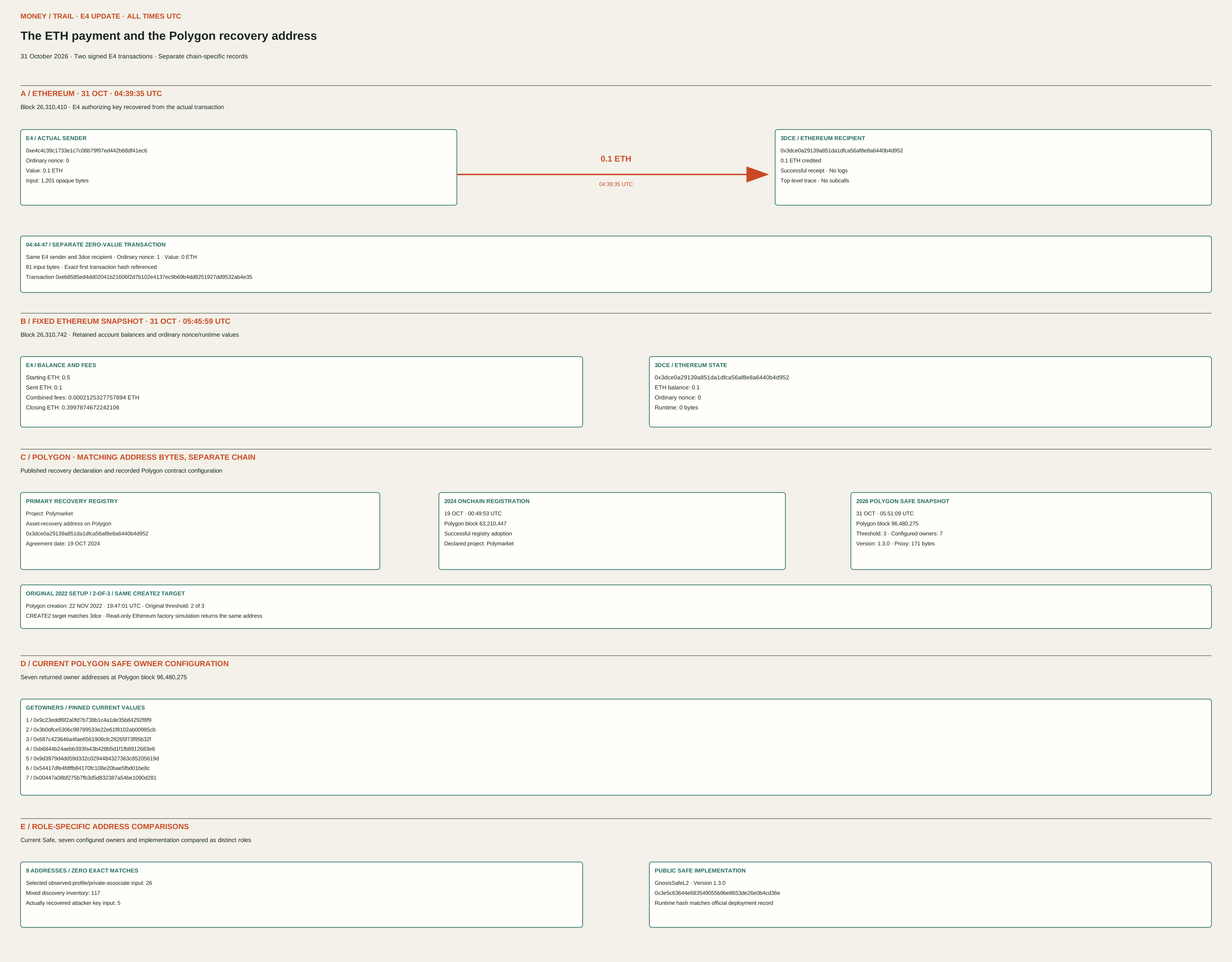
This update checks corporate, product and order-attribution evidence. The money chart retains its displayed snapshot time; no new live balance check is included.